Rock a Bye Baby Rock a Bye Baby Sean Paul Lyrics
| Rock-a-farewell Babe / Hush-a-bye Baby | |
|---|---|
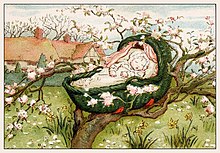 Analogy by Kate Greenaway, 1900 | |
| Publication date | c. 1765 |
| Read online | Rock-a-bye Baby / Hush-a-good day Infant at Wikisource |
"Stone-a-cheerio infant on the tree top" (sometimes "Hush-a-adieu baby on the tree top") is a nursery rhyme and lullaby. It has a Roud Folk Song Index number of 2768.
Words [edit]
First publication [edit]
The rhyme is believed to take start appeared in print in Female parent Goose's Melody (London c. 1765),[1] possibly published by John Newbery, and which was reprinted in Boston in 1785.[ii] No copies of the first edition are extant, simply a 1791 edition has the post-obit words:[3]
Hush-a-past baby on the tree summit,
When the wind blows the cradle will rock;
When the bender breaks the cradle will fall,
Down tumbles baby, cradle and all.
The rhyme is followed by a annotation: "This may serve as a warning to the proud and aggressive, who climb so high that they generally autumn at last."[3]
Modern versions [edit]
Modernistic versions often alter the opening words to "Stone-a-bye", a phrase that was commencement recorded in Benjamin Tabart's Songs for the Nursery (London, 1805).[2] [four]
A 2021 National Literacy Trust case has these words:[5]
Stone a bye infant on the tree top,
When the wind blows the cradle will rock,
When the bender breaks the cradle volition fall,
And downwards will come infant, cradle and all.
Origin [edit]
The scholars Iona and Peter Opie note that the historic period of the words is uncertain, and that "imaginations accept been stretched to give the rhyme significance". They list a variety of claims that have been fabricated, without endorsing whatever of them:[1]
- that the babe represents the Egyptian deity Horus
- that the first line is a corruption of the French "He bas! là le loup!" (Hush! There'southward the wolf!)
- that information technology was written past an English Mayflower colonist who observed the way Native American women rocked their babies in birch-bark cradles, suspended from the branches of copse[ii]
- that it lampoons the British royal line in the time of James 2.
In Derbyshire, England, one local legend has it that the vocal relates to a local character in the tardily 18th century, Betty Kenny (Kate Kenyon), who lived in a huge yew tree in Shining Cliff Wood in the Derwent Valley, where a hollowed-out bough served as a cradle.[6]
Tunes [edit]

"Hush-a-adieu infant" in The Baby's Opera A book of old Rhymes and The Music by the Earliest Masters, ca. 1877
The rhyme is generally sung to one of 2 tunes. The but one mentioned by the Opies in The Oxford Book of Nursery Rhymes (1951) is a variant of Henry Purcell's 1686 quickstep Lillibullero,[i] but a 2d is pop in the United states of america.
In 1887 The Times carried an ad for a performance in London by a minstrel grouping featuring a "new" American song called 'Stone-a-cheerio': "Moore and Burgess Minstrels, St James's-hall TODAY at 3, TONIGHT at 8, when the following new and mannerly songs volition be sung...The great American song of Stone-A-BYE..."[seven] An commodity in The New York Times of Baronial 1891 referred to the tune beingness played in a parade in Asbury Park, N.J.[8] Newspapers of the period credited its limerick to two separate persons, both resident in Boston: Effie Canning (afterwards referred to as Mrs. Effie D. Canning Carlton,[9] [ten] and Charles Dupee Blake.[11]
See besides [edit]
- Rock-a-Cheerio Your Baby with a Dixie Melody
- Rock-a-Bye Lady by Eugene Field
- Rockabye (song) – 2016 unmarried by Clean Bandit
Reference [edit]
- ^ a b c Opie, Iona; Opie, Peter, eds. (1997). The Oxford Dictionary of Plant nursery Rhymes (2nd ed.). Oxford: Oxford Academy Printing. p. 70. ISBN978-0-xix-860088-half-dozen.
- ^ a b c H. Carpenter and G. Prichard, The Oxford Companion to Children's Literature (Oxford University Press, 1984), pp. 326.
- ^ a b Prideaux, WF (1904). Female parent Goose'south Melody : A facsimile reproduction of the earliest known edition. London: AH Bullen. p. 39. A reproduction of Female parent Goose's Melody : Or, Sonnets for the Cradle, published by Francis Power (grandson to the tardily Mr J Newbery), London, 65 St Paul's Chuchyard, 1791.
- ^ Morag Styles, From the garden to the street: an introduction to 300 years of poetry for children (Cassell, 1998),p. 105.
- ^ "Stone a bye baby". Words for Life (National Literacy Trust) . Retrieved 24 November 2021.
- ^ "Ambergate Walk leaflet" (PDF). Ambervalley.gov.uk. Archived from the original (PDF) on 2007-09-28.
- ^ The Times, Monday, Sep 19, 1887; pg. 1; Consequence 32181
- ^ New York Times, Baronial 4, 1891 (p. 1) refers to the tune being played at a Baby Parade at Asbury Park, Due north.J.: "The line of march formed at the Asbury Avenue Pavilion, and, headed by the full band of the The states steamship Trenton playing "Stone-a-Bye Baby," proceeded up the promenade and countermarched, returning in files of four."
- ^ New York Times, Dominicus Jan 7, 1940, Section: Obituaries, Folio 51: "MRS. CARLTON DIES; Equanimous LULLABY; Wrote 'Stone-a-Bye Baby' at Historic period of xv--Succumbs in Boston Hospital at 67 WAS ACTRESS thirty YEARS Played Reverse Gillette in 'Individual Secretary' and in Own Repertory Grouping..."
- ^ "The composer of the popular song, "Rock-a-Goodbye Baby", which beautifully adapts and incorporates the former and familiar lullaby, is Miss Effie L. Canning, a young girl who was born and formerly lived in Rockland, Me. She is at present a resident of Boston. Her success at either poetry or music had not been specially keen until, by a sort of sudden inspiration, she 1 day produced the now celebrated lullaby whose popularity, information technology is a pleasure to land, in the face of then many dissimilar instances, has been a source of much profit to the composer. Miss Canning is a tall, slender girl, with big brown optics, full of the sympathy that finds its best expression in art." New York Times, Wednesday September ten, 1893, Page eleven).
- ^ "Charles Dupee Blake, aged 50-seven, widely known as a composer of popular music...died yesterday at his habitation in Brookline (Boston)...Mr. Blake equanimous more than 5,000 songs and pieces of music. Probably his best known work is Rock-a-Bye Babe." New York Times, Wed November 25, 1903, p. 9.
Rock a Bye Baby Rock a Bye Baby Sean Paul Lyrics
Source: https://en.wikipedia.org/wiki/Rock-a-bye_Baby
0 Response to "Rock a Bye Baby Rock a Bye Baby Sean Paul Lyrics"
Post a Comment